Writing a master's thesis
Outline a chapter with Sonnet, then have Gemini stress-test the argument against your sources. Switch to Opus for the final pass when the prose has to sing. Every conversation stays attached to the same draft.
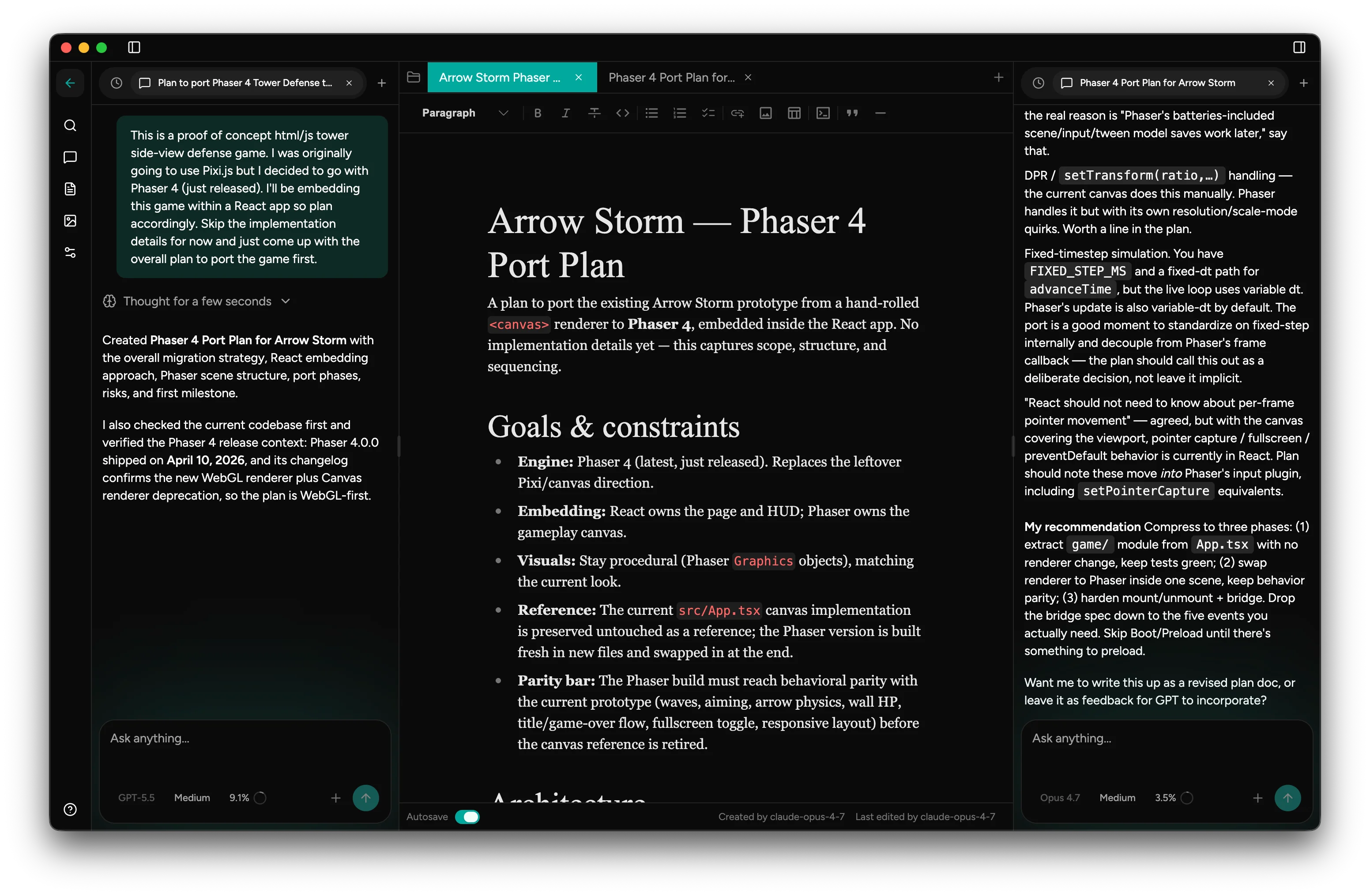
Trident is a desktop AI workspace where Anthropic, OpenAI, and Gemini run side‑by‑side on the same project. Same documents, same context, two chat panels — pick the right model for each turn.
Free to download. Bring your own API keys. Keys are encrypted and stored locally.
Bring your own API keys. Trident routes each turn to the model you pick, with the full project — documents, conversation history, generated images — visible to whichever side is active.
Flagship and legacy models. Long-form thinking, careful editing, the voice that shows up in product copy.
Flagship and legacy models with reasoning effort dialed per conversation — from low latency to slow, careful work.
Flagship and legacy models. Deep multi-modal reasoning or fast iteration — pull either side onto the same project at any moment.
Trident is built around collaboration — between you and the models, and between the models themselves. Every feature is a way to keep that conversation moving on one body of work.
Two models, one project. Bounce a draft between them, ask them to critique each other, or split the work — outline on the left, prose on the right.
Both models — and you — work on the same files. Edits made by either side appear instantly on the other. No copy-pasting between tabs.
Embed a project once and the agent — and the command palette — can search every document by meaning, not keyword.
Generated images live alongside their prompts and the conversation that produced them. Re-run with a different model in one click.
⌘K opens to your projects, conversations, and documents. Searches embeddings inline.
Dial reasoning effort per conversation — Low for quick passes, Max for slow, careful collaborators. Same model, different temperament.
Trident is at its best on the work that takes weeks, not minutes — where the strengths of different models actually compound.
Outline a chapter with Sonnet, then have Gemini stress-test the argument against your sources. Switch to Opus for the final pass when the prose has to sing. Every conversation stays attached to the same draft.
Drop interview transcripts and papers into a project. Ask GPT-5 to surface themes while Claude drafts a synthesis — both reading the same corpus, both citing the same files. Compare the takes side-by-side.
Keep a project per book — chapters, character notes, timeline. Use one panel as your editor, the other as a second reader who's been with the manuscript from page one. Continuity becomes the workspace's job, not yours.
One model plays optimist, the other plays critic. The spec doc sits between them, picking up edits from both sides — and from you — until the design is ready to share with the team.
Contracts, RFPs, grant proposals. Ask both panels to flag risks independently — when they agree, you have a real issue. When they disagree, you have a question worth asking.
Outline lessons with one model, generate worked examples and exercises with the other — same syllabus document, two voices, all the way through to slides and handouts.
Paste API keys from any of the three providers. Encrypted at rest, on your disk. No Trident server in the loop.
Pick a folder. Add documents. Embed the project once and the agent can navigate it by meaning.
Two conversations, two models, one project. Swap providers per turn — same context, different perspective.
Ask any model to make an image and Trident hands you a config card — write the prompt, pick the image model, set dimensions and quality, and the result drops straight into your project gallery.
Trident is a desktop app. Projects sit in folders on your disk. API requests go directly from your machine to the provider you picked — Trident has no backend that sees your prompts.
Keys are encrypted with your OS keychain. Plain text never touches disk.
Documents, conversations, and embeddings live in a local pglite database right next to your project files. Portable, inspectable, yours.
Every request hits Anthropic, OpenAI or Google directly. Trident is the client, not the middleman.